

For better or worse, AI is starting to have a massive impact on society. In terms of animal welfare, there is an opportunity to harness it for good but also deep concern about its potential to bring even more misery to animals. Without the societal shift in attitudes to animals, it is likely that AI will mostly only make things worse.
AI in testing, veterinary science and for companion animals
AI has the potential to accelerate the replacement of animals in testing, supporting analysis of huge datasets as an alternative. Max Taylor, researcher at Animal Charity Evaluators and currently writing a book on AI for animals, believes testing is likely to be one of the first real success stories of AI in helping animals. AI and datasets can be coupled with other forms of technology such as cell-based ‘organs on a chip’, with a number of companies working to create miniature versions of livers, kidneys and other organs that can be used to replicate how the body responds to different drug treatments, diseases and other impacts.
It is also being harnessed in veterinary science, both for companion and farmed animals. As with humans, AI has the potential to, for instance, detect cancer cells at an early stage. Wherever AI is used, there will be questions about the quantity and quality of the datasets that support it, with a direct impact on the accuracy of the models. There are likely to be unscrupulous and misleading uses, such as apps that purport to understand a companion animal’s health or emotions. There is far less debate about ethics in the veterinary context than in human medical care at present.
Max is sceptical about how AI is likely to affect companion animals. “This feels like something that’s going to come out relatively soon because there will be so much demand for devices where you can use AI to train your dog or talk to your cat or whatever”. He adds: “If you are being optimistic, then that could be great because right now we’re not really doing right by the animals that we live with, probably a lot of the time… I guess the caveat is that most of the AI training tools out there at the minute just don’t look great. I think they’re clearly just a cash grab, very gimmicky.”
For both wild and companion animals, one possible area where there could be sweeping, tangible benefits is to embed AI and sensor technology in vehicles to better identify animals, thereby reducing the current carnage on roads. This is already in some vehicles, such as Teslas in self-drive mode, and would presumably be standard in fully autonomous ones. At the same time, even here, the bias is already towards identifying larger animals – such as deer – rather than smaller ones – such as rabbits or foxes – because the former are the most likely to cause damage to vehicles.
AI and factory farming
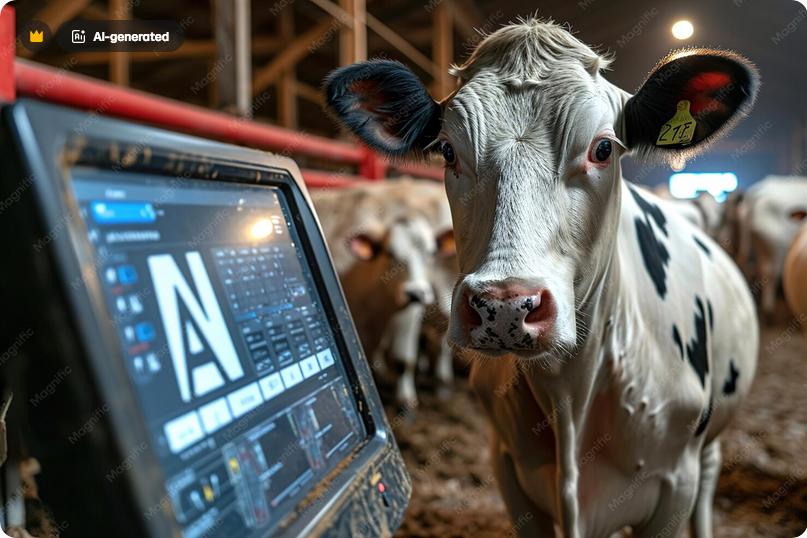
Tech giants are already building AI into systems to make factory farming even more efficient. Sometimes classed as ‘precision livestock farming’, AI and other technologies such as cameras, sensors and microphones are being applied to both animal agriculture and aquaculture in areas that were previously manual interventions. This could accelerate the replacement of lower skilled jobs and see a further centralisation of power, with only large companies able to afford to invest in the technology, hire the skilled staff to use it, and accumulate the massive datasets needed to underpin it.
Technology has enabled facilities such as the many multi-storey pig farms now being built in China, of which the largest to date stands at 26-storeys (one million pigs per year). Machine-learning is also underpinning efforts, initially mostly in the US, to scale up the production of containers to allow the domestication of shrimp farming, with something similar being pioneered for home insect farming.
Technology can automate when to adjust feed, water, temperatures and ventilation, when to administer antibiotics, and for disease prediction, diagnostics and prevention. This is whether in, say, an intensive farmed pig unit (such as listening for patterns of coughs that indicate a problem with the herd) or for companion animals. It could detect how individual chickens are moving to identify physical problems or movement or temperature at a flock level to detect wider health issues, including avian flu. Mass data capture and analysis could also be used to provide more transparency, along the lines of welfare auditing, providing both regulators and consumers with information to make better informed decisions. However, again, there is the question of whether the industry would do this voluntarily, or could there be regulatory pressure?
When it comes to farming, speaking in the panel debate at the launch of the London School of Economics’ Jeremy Coller Centre for Animal Sentience, American philosopher and animal rights activist, Jeff Sebo, who works at New York University, pointed out that there is clearly a claim that precision farming could mean better care. However, “unless this industry is regulated with effective oversight and enforcement, it is not necessarily going to voluntarily choose to optimise for animal health, welfare, rights and flourishing. It will optimise for productivity and efficiency.”
The industry will probably spin a story about improvements, said Jeff, “but that’s not often the case in highly intensive industrial animal agriculture and aquaculture”. It might bring some short-term benefits but his concern is that in the long-term it won’t take us any nearer to true food system transformation. Indeed, it might actually stall momentum by entrenching a perceived – as opposed to actual – ethical legitimacy and environmental sustainability narrative to industrial animal agriculture and aquaculture.
Kevin Xia, now managing director at Hive, a digital platform to connect those involved in animal advocacy for farmed animals, also fears that “as always” the sector’s focus will be on efficiency. It could “unlock existing bottlenecks” in areas such as offshore aquaculture and invertebrate farming. His concern here is that these areas of animal agriculture are, unlike, say, chicken or pig farming, currently quite far from their ‘potential’ in terms of efficiency. So here, with AI, it might not just be a case of making already cheap products a bit cheaper but actually unlocking current blocks to allow them to massively scale.
Says Max: “I don’t want to paint the whole AI farming area with too broad a brush because obviously right now the status quo for farmed animals is terrible and you could definitely use AI in a way to relieve a lot of the worst forms of suffering if you are detecting lots of health and welfare issues early on.” However, he cites developments in breeding techniques which could have been used to breed animals to be more resilient and robust but have, instead, been used to breed them so that they produce as much milk, as many eggs, or as much meat as possible to the detriment of their well-being. “So that’s how we end up with ‘frankenchickens’ and egg-laying hens that suffer from crippling bone disease and all the rest of it because we’re using this kind of technology and know-how for our own benefit rather than for that of the animals.”
Max feels that, on the one hand, the pig skyscrapers in China are a useful hook to show what the future could look like, because most people will be horrified. On the other hand, the reaction could just be, ‘oh, that’s China, things must be better in my country’.
Aquaculture
Similar risks and potential benefits can be assumed for aquaculture, which is one of the areas at the forefront of adoption, with AI being combined with underwater robotics and data science. For instance, Tidal, a spin-off from Alphabet, the parent of Google, claims its software can bring early detection of health issues, such as sea-lice infestations and wounds in salmon farms, as well as optimising feeding. Having initially partnered with Mowi, by April 2025 it was claiming to have installed systems in more than 700 pens around the globe, collected over 30 billion data points, processed 1.5 petabytes (1500 terabytes) of video footage, and monitored over 50 million fish throughout their growth cycle. In some Norwegian salmon farms, there is also now the application of optical lasers to try to delouse fish.
Aquaculture is a newer sector than animal farming, so applying the technology might be easier than trying to retrofit old sheds. The incentive might also be higher because of the challenges of identifying disease and other problems with salmon, other fish, shrimp and so on for the basic reason that they live under water.
Here, as in the farmed animal sphere as a whole, there’s the broader danger that by making the sectors more efficient, AI will not only make them more profitable, ever larger, and ever more consolidated in the hands of fewer and fewer companies, but might also be enough to sustain ones that would have closed without such technologies. If, for instance, AI is used to cut costs and increase productivity of salmon farms through reducing mortality rates and diseases, this might bring welfare benefits in the short-term but could also postpone or permanently put off the closure of farms.
“I am pretty worried,” says Max, “because I think one way that the future could go would be in, say, a few decades we’ve transitioned away from land animal farming to a large extent but replaced it with underwater factory farms, for fish and shrimp. Then we’re just kind of hiding the problem underwater and everyone thinks, ‘oh, now this is great because our farming system is so healthy and sustainable’, and all of the companies of these AI-assisted agriculture farms have slick marketing. Obviously these are still underwater factory farms with all the problems that entails.”
Harnessing AI for Advocacy
On the up-side, the animal agriculture sector is arguably under-investing in AI at present in comparison with many others and here, Kevin Xia feels, lies an opportunity. The pro-animal movement has the potential to be much more agile in leveraging the technology and to steal a leap on the industry as a result.
At the least, it could make animal advocates more productive in their work. As such, there is a need to ensure AI literacy within the movement, including up-skilling and training on relevant tools. It will help to automate research, refine messages and target audiences, and ensure more efficient campaigns in general. This will also make the movement well-positioned as new opportunities to use the technology become apparent. And it could help with lobbying as regulation of the technology starts to mature. There are experts in AI coming into the movement and rejecting commercial positions, incentivised by the need to ensure it is a force for good rather than for profit.
There is Amplify for Animals, which has run a twelve-week AI training programme for animal advocates who want to ‘start and/or strengthen the way they create impact with AI – including those who are curious and eager to explore, as well as those who may feel a little cautious’. Its emphasis was on practical, responsible ways to use AI to save time, boost advocacy, and advance animal protection. It included full access to Team-GPT, which is an AI workspace to try leading AI models (such as GPT, Claude, Gemini, and Perplexity), without the need for separate accounts or paying fees.
Complementing this is Open Paws, which provides open source tools, hackathons, and research to power the animal advocacy movement. The tools to date include an activist chatbot; content tools to create emails, posts and other content; a ‘prospect agent’ to map connections and outreach paths; a news tracker; and an advocacy database to tap into movement insights. There is another set of tools for developers. There are similar initiatives for the not-for-profit sector in general, such as AI Impact Hub.
Mercy for Animals seems to be one of those leading in its adoption of AI tools, perhaps reflected in the fact that in September 2025 it appointed a new president in the form of Arash Yomtobian, a tech leader with 20+ years of management experience at companies like Google and TikTok.
As a researcher, Max Taylor is finding dedicated AI tools are proving useful, so too mainstream ones such as Chat GPT, to research different topics instead of using general web searches that are skewed by sponsors and advertisers. He also feels AI has potential to do better targeted and personalised messaging. Given how helpful these tools can be, Max thinks the key is for advocates to experiment with them and not worry too much about whether they are using them perfectly.
Max also worries that the technology will divide animal advocates, with some rejecting the tools on principle because of the environmental implications, concerns about data security, or worries about AI’s effects on people’s jobs. “I totally see the concerns but we need to keep them in perspective – AI usage makes up a tiny proportion of people’s everyday water and energy consumption, especially when compared to the impacts of, say, eating animal products. I think it would be so damaging if animal and other social justice advocates reject using AI to become more productive, while damaging industries like animal agriculture use it to get ahead.”
Moral Questions and Safeguards
In a different sphere, there is the need to ensure safeguards around, for instance, the response of AI when asked for instructions on how to abuse or use animals. There is lobbying going on but, from the sound of things, little or no willingness to date from the tech giants to engage. The tools draw from the internet, so reflect societal norms/speciesism. In other words, they will provide recipes for fried chicken but not for fried dog; there are recipes with foie gras but not instructions on how to force feed ducks or geese.
While Kevin feels there is an overall notable absence of moral consideration of animals, he is hopeful that AI might aid innovation when it comes to meat substitutes, helping to predict which proteins can most closely match animal ones to produce higher quality replacement products.
What about the potential for AI to crack the Dolittle Coller challenge and unlock two-way communication with other species? Earth Species Project has been set up specifically with this in mind, with significant philanthropy backing, plus finance from Google Cloud. Interim managing director, Jane Lawton, said: “We are not doing this just because we think we can – we definitely think we can – and not just because we think it’s cool.” The first thing people say when told about it, she said, was ‘when will I be able to speak to my cat or dog?’ “We are doing this because we fundamentally believe that communication is a really important window into the intelligences, the cultures, the minds, the lives of other creatures on the planet.” It is the disconnection, she feels, that allows humans to destroy, exploit, and say, ‘we’re different and it’s okay’.
Earth Species Project is essentially developing large language models to try to analyse the signals that are being sent by animals. It has something called NatureLM-Audio, which is an open source platform designed to analyse acoustic signals. It claims the models can be adapted across all species – “from a crow to a whale”, said Jane. “We are looking to accelerate the science and, through that, advance conservation and, very soon I hope, to really create a shift in people’s mind-sets.”
If such a capability is truly attainable, there would be all sorts of risks and ethical questions around the responsible use of the technology. Perhaps the greatest opportunity is just to listen and better understand, said Jane, rather than rushing to two-way communication, so that we avoid intrusion and honour the right of animals to live their lives undisturbed. The fascinating panel discussion that accompanied the launch of the new LSE centre is available on the LSE’s YouTube channel.
Jeff Sebo summed up well: “There is no way of developing and deploying AI that in and of itself is going to have good effects on humans, and animals, and public health, and the environment. There is no silver bullet solution to the problems that we are facing, the harms we are imposing on other species… because ultimately responsible development and deployment of AI has to happen alongside other types of social, political, economic and technical interventions because even the most responsibly developed and deployed technology with good, thoughtful regulation, is not going to have good impacts if anything like current human societies are the ones to make use of it.”
Photo credit: https://www.magnific.com/




Leave A Comment