

When researching my book on the UK animal rights movement, it was great to find individuals and groups who were doing something different from everyone else.
The Vegan Land Movement (VLM) is not, single-handedly, going to change the world. Buying pieces of land at auction, removing them from grazing, and rewilding is slow and small-scale. However, it is based on a wonderful vision; the messaging around it is powerful; and – best of all – it isn’t duplicating what anyone else is doing.
I came across VLM when researching my book, ‘How Long Shall These Things Be? Inspirational Stories from the Front Line for Animals’. In many ways, it was those who had found their own niches, the pioneers, who most stood out.
Doing the interviews, it struck me just how much overlap there is in the movement, particularly among the main charities. I have every respect for those that, for instance, carry out investigations but I thought the situation was summed up by the two entities that inadvertently turned up at the same farm on the same night.
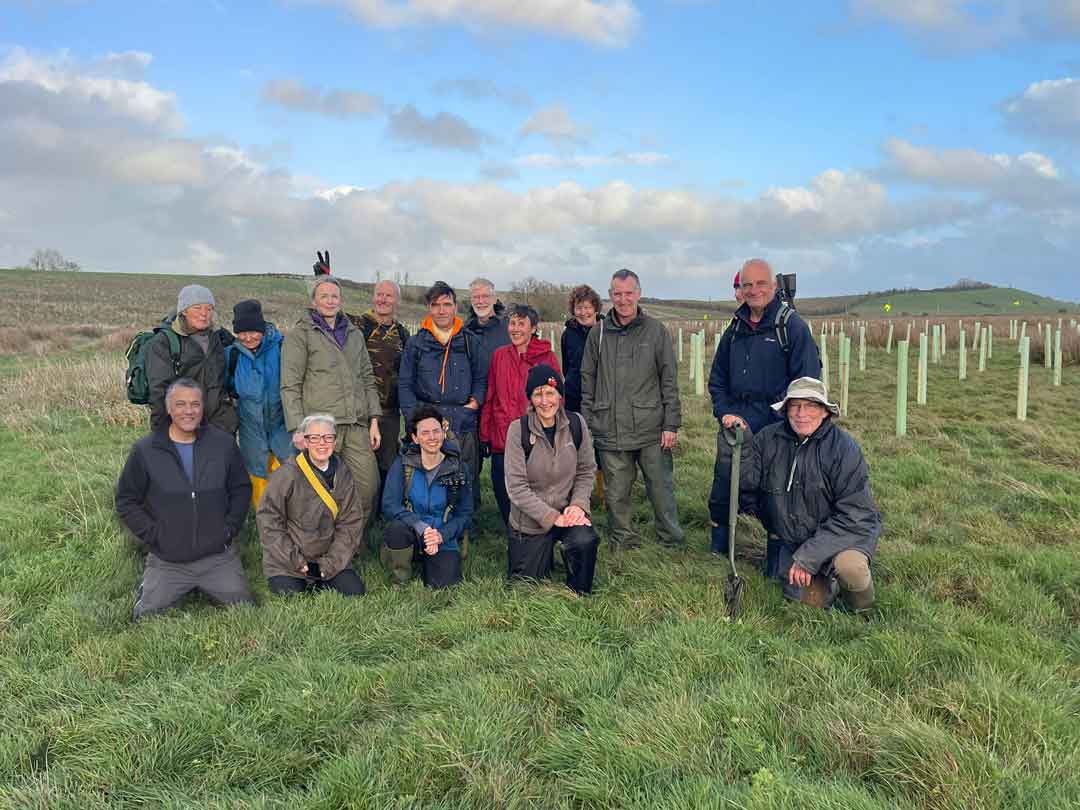
I traveled down to the Somerset Levels to join VLM on one of their volunteer days. We were planting native whips on one of the recently acquired fields (photo above). The previous day, they had just acquired their ninth plot. Crowdfunding allows VLM to bid at auction for dairy land, with the first acquisition made in 2020.
“These are small plots but they are the whole universe to the species that now live there,” pointed out co-founder, Gina Bates. There have been surveys of each plot since the start, so the group has been able to demonstrate and communicate the biodiversity gain.
Between 2022 and 2035, there was a 57.2 per cent increase in fauna species on the initial plots. The overall 2025 count recorded 197 plant species and 217 animal species. This area in Somerset (all the plots have been here to date) is dominated by the gazing of sheep and cattle, resulting in poor biodiversity. The plots are oases that are starting to buzz with life.
Additional benefits include cutting off the fields from access by both the local hunt and the badge cull (this was one of the areas covered by that cruel, pointless pursuit). One of the plots had a planning application for a chicken farm.
Gina and her fellow founders wanted to create a narrative about alternatives rather than protest. The model could certainly be scaled up and applied to other regions. One piece in the jigsaw is the crowdfunding platform, which VLM built to support vegan causes.
Of course, funds are vital. If a million people gave £1 per month, Gina pointed out, “we could buy up a dairy farm every other month”.
For the book, I carried out 60+ interviews, including with the heads of all of the large NGOs. There’s certainly a place for the heavyweight generalists, with their offices, staff and high-profile campaigns. However, I mostly loved those ploughing their own furrow, whether campaigning against particular areas of exploitation, fighting for particular species, or coming up with new solutions. VLM was an absolute case in point.
For information on VLM (and to donate, let’s buy up those dairy farms!) visit:



Leave A Comment